
Written by Alex Deng, Production Manager at ACELION. With over 12 years of hands-on experience in the commercial printing industry—I’ve helped countless independent creators, publishers, and international brands scale from their first prototype to global mass production. Here is my inside look at how we quote and build your decks on the factory floor.
Moving From Estimated Pricing to Exact Manufacturing Costs
When scaling a custom tarot card project from a digital prototype to a mass production run of 500 to 5,000+ units, preliminary online estimates are simply insufficient.
Securing a binding factory quote requires locking down your Bill of Materials (BOM) and prepress specifications upfront.
For independent publishers and brands, an accurate quote relies on defining the technical variables that dictate bulk pricing—from core paper economics to prepress standardization. Nailing these details early protects your profit margins and prevents costly production delays.
This guide outlines the exact parameters required to submit a bulletproof Request for Quote (RFQ).
Beyond the Base Price: Hidden Prepress and Material Variables in Tarot Manufacturing
⚠️ Factory Note: When designing cards with deep, space-black backgrounds, never use a 400% total ink limit (C100/M100/Y100/K100). This causes severe drying issues and ink offsetting on the press, where wet ink transfers to the back of the adjacent card in the stack. We require a “Rich Black” formula of C60, M40, Y40, K100, keeping total ink coverage under 300% to ensure crisp curing before the sheets hit the die-cutting station.
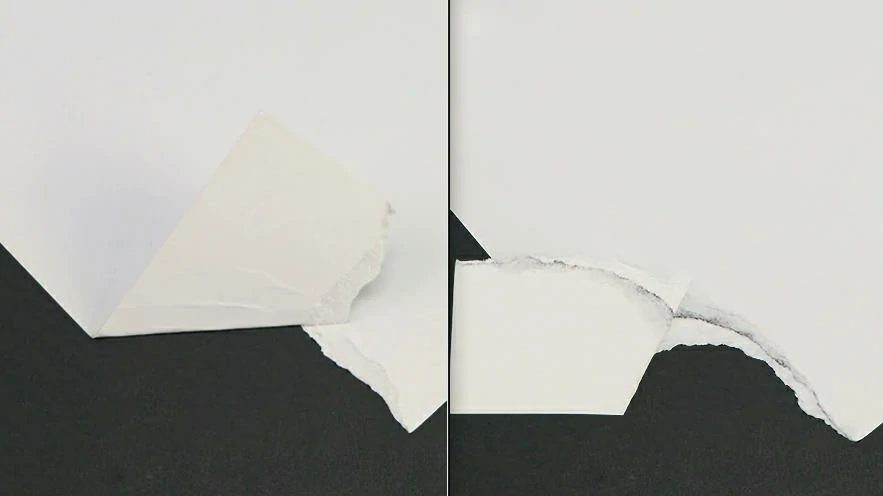
The internal layers of a torn black core card vs. a standard white core card
Cardstock Economics: Why 300gsm German Black Core Yields Better Retail Value Than 350gsm Standard Art Paper
In playing card and tarot manufacturing, grams per square meter (gsm) measures weight, not structural integrity. A common prepress error is assuming a thicker 350gsm standard art paper (C2S) is superior to a 300gsm black core stock.
Standard 350gsm art paper lacks an internal light-blocking layer, meaning high-contrast lighting can reveal printed artwork through the card.
Conversely, 300gsm German black core paper is engineered with an internal graphite layer. This core provides 100% opacity and superior “snap” (the physical memory of the card returning to its flat state after shuffling), which ensures zero light-bleed and high snap, significantly reducing backer complaints after fulfillment and guaranteeing a premium unboxing experience.
When calculating the unit economics for a 1,000-deck production run, specifying black core justifies a premium retail price point due to its structural longevity. For a complete breakdown of material specifications, review our commercial-grade tarot cardstock options.
Prepress Standardization: Avoiding Setup Surcharges Caused by Color Profiles and Bleed Errors
Prepress bottlenecks are the primary cause of delayed production schedules and unexpected setup surcharges.
Submitting files in RGB color space forces the prepress department to run automated CMYK conversions, which often results in color shifting, particularly in deep blacks and vibrant blues. Files must be submitted in CMYK using the GRACoL 2006 Coated1v2 ICC profile.
Furthermore, die-cutting machinery operates with a mechanical shifting tolerance of +/- 0.5mm.

Prepress diagram showing the Safe Zone, Trim Line, and 3mm Bleed Area on a standard 70x120mm tarot card
To accommodate this, all artwork must include a standard 3mm (0.125″) bleed margin extending beyond the trim line, with critical text kept within a 3mm safe zone inside the trim line.
Missing bleeds require manual prepress engineering interventions, directly inflating the final invoice. By standardizing these files upfront, you eliminate costly prepress back-and-forth and ensure your production timeline stays strictly on schedule.
Optimizing Your Bill of Materials (BOM) for Mass Production
⚠️ Factory Note: If your BOM includes both soft-touch lamination and metallic edge gilding, expect a slightly higher defect rate during the edge-sanding process. The BOPP film used for soft-touch finishes has low surface energy and tends to fray microscopically under the sanding block, which can cause the edge foil to adhere unevenly. We mitigate this by using a slower, low-heat gilding process, but you should factor a 2-3% longer production lead time for this specific combination.

Surface Finish Compatibility: Calculating the True Cost of Soft-Touch Lamination vs. Matte UV
Surface treatments directly impact the application and yield rate of secondary finishes like hot foil stamping.
Matte UV is a liquid coating cured by ultraviolet light, offering a cost-effective, scuff-resistant finish that pairs predictably with standard foil stamping.
Soft-touch lamination, however, involves applying a specialized BOPP (Biaxially Oriented Polypropylene) film to the printed sheet.
While it provides a premium tactile feel, the low surface tension of the soft-touch film can cause adhesion issues when applying holographic or metallic foil edges. Manufacturing this combination requires slower machine speeds and specialized foil formulations, which decreases the hourly yield rate and increases the per-unit cost.
Publishers must account for these compatibility variables when selecting advanced surface finishes and foil stamping capabilities. Understanding this trade-off allows you to accurately forecast your profit margins and avoid unexpected delays when combining luxury finishes.

Rigid Boxes

Custom Tuck Box
Packaging & Freight: Volumetric Weight Strategies for Rigid Boxes vs. Tuck Boxes
The architectural design of the deck’s packaging drastically alters international freight costs due to volumetric weight calculations.
A standard tuck box is die-cut from a single sheet of 300gsm to 350gsm C1S paper. It has a minimal footprint and can be shipped flat or pre-assembled, keeping volumetric weight low.
In contrast, a premium two-piece rigid box is constructed from heavy 1200gsm greyboard (approximately 2mm thick) wrapped in 157gsm printed art paper.
If the rigid box includes custom EVA foam or molded paper inserts to hold a guidebook alongside the cards, the overall dimensions expand significantly.
When shipping 1,000 units on standard pallets, the increased cubic volume of rigid boxes will exponentially increase the landed cost (manufacturing cost + freight) compared to tuck boxes. Optimizing your box architecture early on can save you thousands of dollars in international shipping fees, directly boosting your campaign’s net ROI.
Vetting Your OEM Partner: Supply Chain Reliability and Compliance
⚠️ Factory Note: The biggest shock for first-time publishers is the color shift between their digital prototype and the final offset mass production. Digital presses (using toner) run warmer and more saturated than traditional wet inks. To guarantee your 5,000-deck run matches your expectations, always request a physical “wet proof” (hard proof) printed on the actual offset press using your exact chosen cardstock.
FSC Certification and Sustainable Sourcing for Crowdfunding Campaigns
For modern crowdfunding campaigns and retail distribution, environmental compliance is a strict procurement requirement.
Partnering with a manufacturer that holds active FSC (Forest Stewardship Council) Certification ensures that the paper stock is sourced from responsibly managed forests.
Specifying FSC Mix or FSC 100% materials on your BOM mitigates PR risks and meets the compliance standards required by major international distributors, which opens doors to larger retail partnerships and builds immense brand trust with eco-conscious consumers.

Case Study: Scaling a Kickstarter Campaign from 500 to 5,000 Units Without Quality Fade
Scaling production requires strict color management. In a recent production run, an independent publisher transitioned from a 500-unit print pilot to a 5,000-unit offset mass production run.
By standardizing the CMYK profiles and utilizing computer-to-plate (CTP) offset printing technology, we maintained a Delta-E color variance of ΔE ≤ 2.5 across all batches.
This ensured absolute consistency between the initial backer rewards and subsequent retail inventory. This level of consistency protects your brand reputation, ensuring that a deck bought in retail looks exactly as stunning as the one sent to your first Kickstarter backer.
How to Structure Your Request for Quote (RFQ) for Faster Turnarounds
⚠️ Factory Note: “Standard size” means nothing on the factory floor. We’ve seen projects delayed by weeks because a client assumed “tarot size” meant exactly 70x120mm, while their artwork was actually sized for 2.75″ x 4.75″ (69.85×120.65mm). Always specify exact millimeter dimensions in your RFQ to prevent custom die-mold surcharges later.
To bypass estimated pricing and receive a binding manufacturing quote, your RFQ must include the complete technical specifications of your project, which guarantees a binding, accurate quote with zero hidden fees.
Submit the following parameters to our prepress team:
- Card Dimensions: Exact width and height in millimeters (e.g., 70mm x 120mm).
- Card Count: Total number of cards per deck (e.g., 78 cards).
- Core Material: Specific paper grade and core (e.g., 300gsm German Black Core).
- Surface Finish: Coating or lamination type (e.g., Matte UV coating, Linen finish).
- Secondary Finishes: Add-ons and their exact placement (e.g., Gold foil stamping on card backs, Matte black edge gilding).
- Packaging Architecture: Box type and material (e.g., 2-piece rigid box with 1200gsm greyboard, custom paper insert).
- Booklet Specifications: Page count, binding type, and paper weight (e.g., 64-page perfect bound, 105gsm interior text).
- Target MOQ (Minimum Order Quantity): Tiered pricing requests (e.g., Quote for 500 / 1,000 / 2,500 units).
- Shipping Destination: City and Postal/ZIP code for accurate freight and landed cost calculations.
Ready to lock in your production budget? Submit your technical specifications to our prepress engineers for a comprehensive, factory-direct manufacturing quote.


